
Stitch types overview
Every object carries a stitch style that decides how its path is turned into thread. This page is a map of the styles Octostitch offers and when to reach for each; follow the links for the full settings of each one.
Outlines vs fills
Section titled “Outlines vs fills”Broadly, stitch types fall into two groups:
- Line stitches follow a path as a line — for outlines, detail and travel.
- Area / column stitches cover a region with thread — for solid shapes, lettering and borders.
Line stitches work on open or closed paths; area fills only generate stitches for closed paths.
The stitch styles
Section titled “The stitch styles”| Style | Use it for | Reference |
|---|---|---|
| Running | Thin outlines, detail lines, travel runs | Running & bean |
| Bean | Bolder outlines (each stitch repeated back-and-forth) | Running & bean |
| Wide run | Thick lines — a band of parallel rows following a path | Wide run |
| Zigzag | Simple width-along-a-line stitching | Zigzag |
| Satin column | Lettering, borders, tapering shapes | Satin column |
| Fill | Large filled areas (tatami, circular, spiral, satin fill) | Fills |
| Appliqué | Fabric appliqué with placement, tackdown and border | Appliqué |
| Decorative | Repeating motif tiled along a path | Decorative |
| Manual | Hand-placed stitches for full control | Manual stitch |
| Guide | A non-stitching path that steers a fill or cuts a seam through it (no thread) | Guides & cut lines |
Redwork routing isn’t a style of its own — it’s an option on running and bean that sews the whole object’s line work as one continuous thread instead of subpath by subpath. See Redwork routing.
Neither is a gradient — it’s an option on parallel and satin fills that blends the fill through several thread colours, sewing one pass per colour. See Gradients.
Choosing a stitch type
Section titled “Choosing a stitch type”- Text and lettering → satin columns for smaller text; fills for large letters.
- A traced shape you want in satin → draw it as an outline, then convert it to a satin column rather than building the rails by hand.
- Borders and outlines → satin column (smooth, glossy), running/bean (thin), or a wide run where you want a thick line that still reads as parallel rows of running stitch rather than solid coverage.
- Traced line art, monograms and quilting motifs → running or bean with redwork routing, so the whole drawing sews as one thread instead of a stroke at a time.
- Large areas → a fill; use a guide if you want to control the fill direction around curves, or as a cut line to draw a seam through it.
- Appliqué → the appliqué style, which emits the placement line, tackdown and border with the machine STOPs in the right places.
Whatever you choose, add underlay where it helps and check the result in Simulation view before exporting.
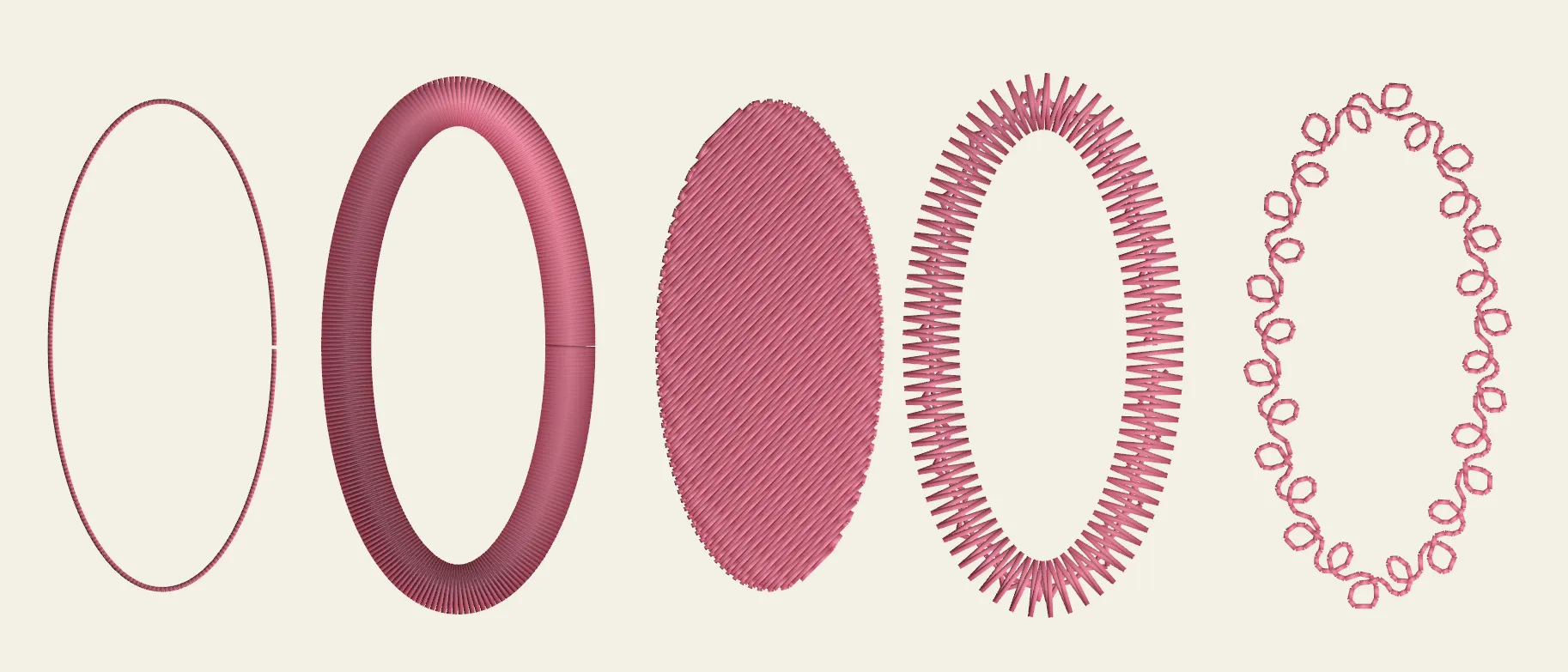 The same kind of shape stitched as running, satin, fill, appliqué and decorative.