
Zigzag
A zigzag stitch runs the thread from side to side along a path, at a fixed width. It’s a simpler, lighter alternative to a satin column for narrow borders and outlines, and it’s what an appliqué tackdown uses.
Width & density
Section titled “Width & density”- Width (
width_mm) — how far the zigzag swings to each side of the path. - Spacing (
spacing_mm) — the density, measured peak to peak: the distance between two needle penetrations on the same side. Smaller spacing = denser, more solid coverage; larger spacing = a lighter, more open zigzag. New zigzags start at 0.35 mm.
Because the width is set for the whole object, a zigzag gives an even band. To vary the width along the path (a taper), add meta nodes.
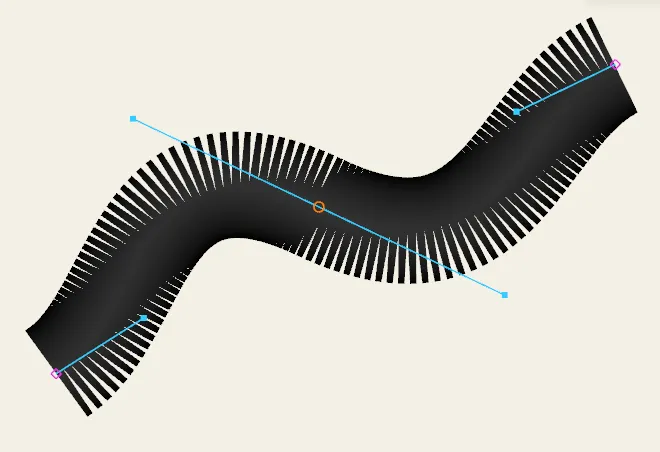 A zigzag along a curved path — the band stays centred on the line at a constant width, with spacing setting how dense the bites are.
Corners
Section titled “Corners”Where a path turns sharply, a zigzag can’t simply carry on across the joint — the outer edge has to travel much further round the turn than the inner edge does. Left alone, that leaves a wedge of bare fabric on the outside of the corner and a pile-up of thread on the inside.
Octostitch detects any turn sharper than about 20° and fans the stitches through it: the stitches pivot around a single point on the inside of the turn and sweep round to cover the outside, the way a mitred corner works. Curves gentler than that are stitched straight through as ordinary curvature, so a smooth path is unaffected.
You don’t have to configure any of this — but it’s worth knowing what you’re looking at when a corner in the preview shows stitches radiating from one point. On a very tight hairpin the fan is capped rather than allowed to spike arbitrarily far back up the path, which can leave a small unstitched sliver right at the tip. If that shows, round the corner off slightly with the Edit tool or widen the turn.
Two sharp corners close together share the path between them, so neither fan eats into the other’s stitching.
Max stitch length
Section titled “Max stitch length”- Max stitch length (
max_stitch_mm) — optional; off unless you switch it on. A wide zigzag throws a long stitch straight across itself, and nothing holds the middle of it down, so it snags and drags the fabric in. Capping the length breaks those stitches into shorter parts with extra needle drops along the way.
The split points are staggered on alternate stitches, so they don’t line up into a seam sewn down the middle of the column. The cap also covers the corner fans, where the stitch reaching from the inside pivot to the outer edge of a turn is the longest thread in the whole run.
Pull compensation
Section titled “Pull compensation”- Pull compensation (
pull_comp_mm) — widens the zigzag slightly to counteract the way fabric pulls in under stitching. Without it, a zigzag can end up narrower on the fabric than it looks on screen. See Satin column for more on why pull compensation matters.